Skip to content

Charleston Dolphin Tour vs Harbor Cruise

Charleston's dolphins are residents, not visitors, so most harbor cruises run into them anyway. Here is how to pick the boat that suits you.

Written by Alex H., a Charleston local Updated August 2026

Short answer: Charleston's dolphins live in the harbor year-round, and most harbor cruises run into them without trying. So the real choice is about route and boat, not about dolphins. For the skyline, Fort Sumter and likely dolphins, take a harbor sightseeing cruise from $35. For small groups, shallow creeks and time spent watching rather than narrating, take a dedicated dolphin trip out of Folly Beach. For the prettiest two hours on the water, take a sunset cruise.

Most Charleston harbor cruises see dolphins anyway

The dolphins here are not passing through on a migration. NOAA Fisheries manages them as the Charleston Estuarine System stock, a resident group whose range is bounded to the north by Price Inlet and runs through the harbor, up the main channels and creeks of the Ashley, Cooper and Wando Rivers, and south through the Stono River estuary to the North Edisto. NOAA's stock assessment names Charleston Harbor itself as a high-use area for that stock.

They are here in every season. Photo-identification surveys catalogued 839 individual dolphins in the Charleston system between 1994 and 2003, and among the animals seen most often, 81 percent turned up over a span longer than five years. Earlier work in the Stono River estuary identified year-round residents. NOAA's most recent published abundance figure, an average of January 2005 and January 2006 surveys, was 289 animals, and the agency flags it as an undercount because those surveys did not cover the whole stock range. There is no newer estimate.

That is the fact the head-to-head question hides. A sightseeing boat crossing the harbor is crossing water a few hundred resident dolphins use daily, which is why Charleston's most-booked water trip is sold as a harbor tour and dolphin watch in the same breath. No operator can promise wildlife and the honest ones do not try. But if seeing a dolphin at all is the bar, a standard harbor cruise clears it on most days.

So choose on the things that genuinely differ: how long you are out, how close to the water you sit, whether the guide is talking about Fort Sumter or about mullet, and what you want to pay.

Charleston dolphin tours and harbor cruises at a glance

Harbor sightseeing cruise
90 minutes to 2 hours, from $35 (as of August 2026)
Dedicated dolphin boat trip
90 minutes to 2 hours, roughly $52 to $110
Kayak or paddleboard safari
About 2 hours, around $59, launching from Folly Beach
Sunset harbor cruise
2 hours, from $66
Best time of day
Early morning or the last two hours before sunset: flat water, low glare, less boat traffic
Best tide
A falling tide into low water. Strand feeding happens two hours either side of low tide
Dolphin likelihood
High in every season. Charleston Harbor is resident dolphin habitat, but no operator can guarantee wildlife
Viewing distances
NOAA asks 50 yards from a boat; on foot at a strand-feeding beach, stay at least 15 yards back. Feeding a wild dolphin is a federal offense
Harbor cruise suits
First-timers, mixed-age groups, anyone who wants Fort Sumter and the Battery explained
Dolphin tour suits
Wildlife-first travelers, photographers, small groups happy to sit in a creek and wait
Harbor Cruise Dolphin Tour
Typical length 90 minutes to 2 hours 90 minutes to 2 hours by boat, about 2 hours by kayak
Price From $35 Roughly $52 to $110 by boat, around $59 by kayak
Where it goes The main harbor: the Battery, Fort Sumter, the Ravenel Bridge, the Cooper River waterfront The Folly River, the Stono, and the creeks and shallows behind Morris Island
Dolphins Usually seen. The harbor is resident dolphin habitat The whole point. The captain works the shallows and can idle and wait
Narration Guided history commentary the whole way Wildlife and marsh ecology, little history
The boat Large, usually two decks, restrooms and covered seating Open outboard for 6 to 20 people, or your own kayak
Best for First-timers who want the classic harbor experience Anyone getting on the water specifically for the wildlife

Strand feeding, the thing worth planning around

Charleston's dolphins do something almost no other dolphins do. A small group herds a school of mullet toward a mud bank, then charges, pushing a wave that throws the fish out of the water and onto the mud. The dolphins ride it up, heaving as much as two-thirds of their bodies onto the flat, grab what they can and slide back. It is called strand feeding.

On the entire US East Coast it has been documented only in the tidal creeks and marshes of South Carolina and Georgia. The worldwide list of places is short, with the Gulf of Guayaquil in Ecuador among the few others. Researchers described the behavior in detail from Bull Creek, South Carolina, in a 2008 Marine Mammal Science paper by Duffy-Echevarria, Connor and St. Aubin.

It runs on the tide rather than the clock. The Town of Seabrook Island, which operates a dolphin education program on its beach, puts the window at two hours either side of low water, when the creeks drain and the mud banks come up. Captain Sam's Spit on Kiawah Island is the one spot where you can watch it on foot instead of from a boat.

It is also the part of Charleston dolphin watching most threatened by the people who come to see it. Beachgoers on Kiawah have tried to touch, chase and hand-feed stranding dolphins. Crowding animals mid-hunt changes what they do, and strand feeding is learned behavior passed from mother to calf, so a disturbed hunt costs more than one meal. Approaching or encouraging it is illegal, not merely frowned upon.

The rules are federal, and they are short

Dolphins in US waters are protected by the Marine Mammal Protection Act of 1972. Two rules matter to anyone on a boat or a beach here.

Stay back. NOAA Fisheries asks boaters and swimmers to remain at least 50 yards from dolphins and porpoises, about half a football field, and at least 100 yards from whales. On the beach at a strand-feeding site, Seabrook Island asks for 15 yards, roughly 45 feet, back from the water line, with dogs leashed and noise kept down. If dolphins come to you, put the engine in neutral and let them pass.

Never feed them. NOAA's wording is blunt: do not feed, or attempt to feed, any marine mammal, because it is harmful and illegal. Fed dolphins lose their wariness of boats, take hooks and lines, and pass the habit to their calves. Feeding or harassing a wild dolphin carries civil penalties that adjust annually for inflation, over $36,000 as of 2026, and up to a year in jail.

Booking a licensed tour is the easy way to stay on the right side of all this. The captain works under those rules every day and will hold the distance for you.
The boat matters more than the label on the ticket

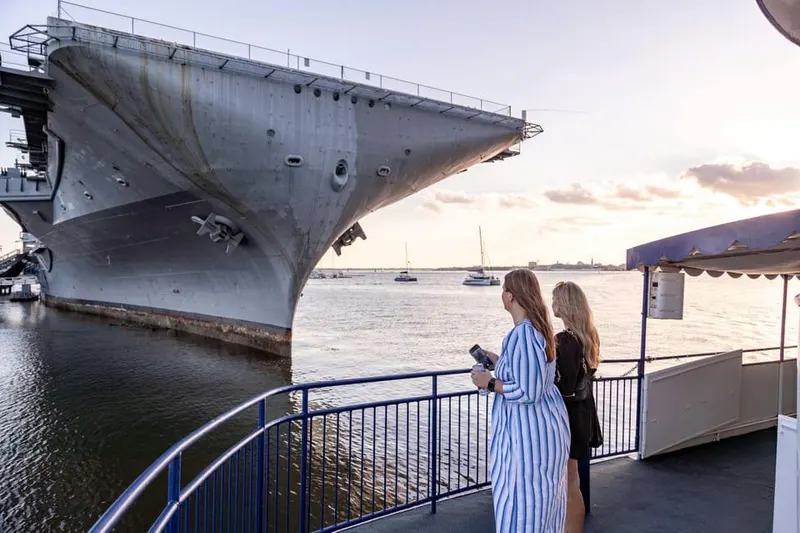
Large narrated tour boats carry a hundred or more passengers on two decks, with restrooms, covered seating and a guide on a microphone. SpiritLine, the long-running downtown operator, runs its harbor tour at 90 minutes. You sit high above the water, which is good for spotting a dorsal fin at distance and bad for the close, eye-level look most people picture. The boat is on a route and a schedule, so a dolphin off the bow is a moment rather than a stop. It is also the steadiest ride, the cheapest, and the only sensible pick with small children, mobility limits or a delicate stomach.

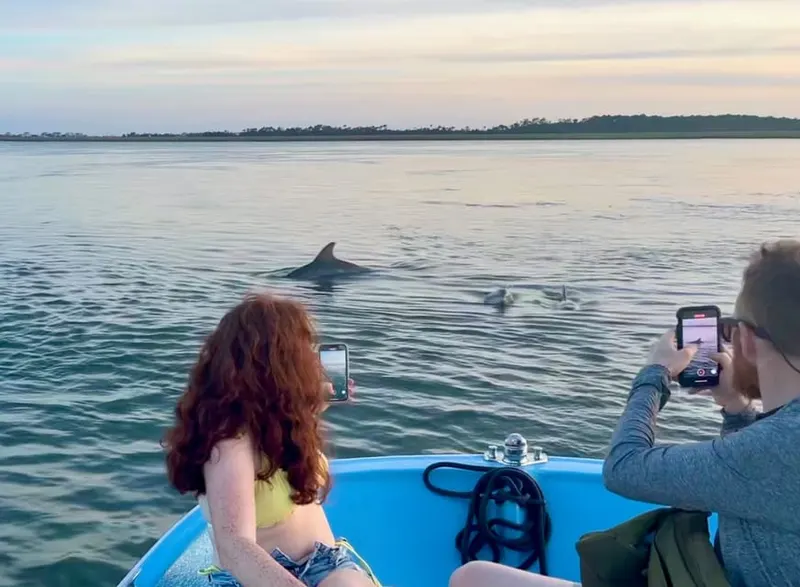
Small-group boats take six to twenty people in an open outboard that sits low and draws little water, so it can work the creeks behind Folly Beach and Morris Island where a double-decker cannot follow. The captain can shut down and wait, which is what actually produces good dolphin watching. The trade-offs are real: no restroom, no shade, weather cancels more often, and the price per person roughly doubles.

Kayaks and paddleboards put you at the dolphin's eye level with no engine noise at all. Folly outfitters run morning, afternoon and sunset safaris of about two hours on the Folly River for around $59. It is the most intimate version and the least controllable: you cannot cover ground, you cannot reposition quickly, and you are managing wind, tide and your own arms for two hours. Good for reasonably fit adults and teenagers, poor for toddlers and for anyone who has never paddled.

Time of day and tide

Morning is the standard advice, and the reasons are mostly about conditions rather than dolphin behavior. Early water is flatter, the sea breeze has not come up, glare is low and the harbor carries less traffic, all of which makes a fin easier to see. The last couple of hours before sunset bring the same calm plus better light for photographs. Midday trips in summer are the hottest, brightest and busiest.

Tide is the more useful variable on a creek trip. Dolphins hunt where fish get concentrated, and a falling tide drains the marsh and pushes baitfish out of the spartina and into the channels. That is also the strand-feeding window, two hours either side of low water. NOAA publishes tide predictions for Charleston Harbor, so you can check yours before you choose a departure time. On a large-boat harbor cruise the tide barely matters.

Three ways to get on the water

Pick by what matters most. Prices and ratings are from the live listings as of August 2026.

Charleston: Sightseeing Harbor Tour & Dolphin Watch
Best all-rounder

Sightseeing Harbor Tour & Dolphin Watch

From $35 · 4.5★ (670)

The classic Charleston-from-the-water trip: the skyline, the Battery, the Ravenel Bridge, and Fort Sumter, with dolphins usually thrown in. The most-reviewed, most affordable way onto the harbor.

Check availability →
Charleston: Morris Island Dolphin Cruise with Beachcombing
Best for dolphins

Morris Island Dolphin Cruise with Beachcombing

From $110 · 5.0★ (38)

A dedicated wildlife trip that heads for the creeks and shallows where the local pods feed, rather than the busy main harbor. Small groups, and the captain can idle and wait.

Check availability →
Charleston: Sunset Harbor Cruise
Best for romance

Sunset Harbor Cruise

From $66 · 4.7★ (295)

The skyline glowing orange as the sun drops behind the bridge. Calmer water, a drink in hand, and the prettiest hour to be out. The pick for couples.

Check availability →

The honest verdict

Book a harbor sightseeing cruise if this is your first time in Charleston, you want the Battery, Fort Sumter and the Ravenel Bridge explained while you are looking at them, and you would be pleased rather than crushed if the dolphins stayed away. The Sightseeing Harbor Tour and Dolphin Watch runs 90 minutes from $35 and holds 4.5 stars across 670 reviews, more feedback than any other water trip in the city.

Book a dedicated dolphin trip if wildlife is the whole reason you are getting on a boat, you want a small group, and you would rather sit still in a creek than motor past landmarks. Trips out of Folly run roughly $52 to $110 for 90 minutes to two hours and work the water around the Folly River and the Morris Island Lighthouse.

Book a sunset cruise instead of either if you are a couple, if it is an occasion, or if this is the one evening you have on the water. The Sunset Harbor Cruise is two hours from $66 at 4.7 stars over 295 reviews, the best-rated of the three, and the dolphins are still there. The light on the Cooper River waterfront is the point.

If you want the water and the city history without booking twice, the Historic City Tour and Harbor Cruise pairs a guided city tour with a harbor cruise across about four hours from $63, rated 4.5 over 261 reviews. And if it is Fort Sumter you actually want, no harbor cruise lands there. The fort has its own NPS-authorized ferry from Liberty Square and Patriots Point, about two and a quarter hours round trip with roughly an hour on the island.

Whichever you choose, the deep dives are a click away: every dolphin operator by departure dock in the dolphin tour guide, every narrated boat with direct prices in the harbor cruise guide, and the rest of Charleston's boats, paddling trips and fishing charters on the water activities guide.

Book a Charleston harbor or dolphin cruise

Full breakdown, pricing, and where to book each one:

Frequently Asked Questions

Is a Charleston dolphin tour or a harbor cruise better?

For most visitors, a harbor cruise. Charleston's dolphins are a resident population that lives in the harbor year-round, so a standard sightseeing cruise usually finds them while also covering Fort Sumter, the Battery and the Ravenel Bridge. Book a dedicated dolphin trip only if wildlife is the entire reason you are getting on a boat.

Are you guaranteed to see dolphins in Charleston?

No tour can guarantee wild animals, but the odds are good. NOAA manages the local dolphins as the Charleston Estuarine System stock and names Charleston Harbor a high-use area for them. Its most recent published estimate, from January 2005 and 2006 surveys, averaged 289 animals and is flagged as an undercount.

How much does a Charleston dolphin tour cost?

As of August 2026, a harbor sightseeing and dolphin-watch cruise starts around $35 for 90 minutes. Dedicated small-boat dolphin trips out of Folly Beach run roughly $52 to $110. Kayak and paddleboard dolphin safaris are about $59 for two hours. Sunset harbor cruises start around $66.

What is the best time of day for dolphin watching in Charleston?

Early morning or the last couple of hours before sunset. Both give flatter water, less glare and less boat traffic, which makes fins far easier to spot. Tide matters more than the clock on creek trips: a falling tide drains the marsh and pushes baitfish into the channels.

How close can a boat get to dolphins in Charleston?

NOAA Fisheries asks boaters to stay at least 50 yards away from dolphins, about half a football field, and to shift into neutral if animals approach. On foot at a strand-feeding beach, stay 15 yards back from the water line. Feeding or harassing wild dolphins is illegal under the Marine Mammal Protection Act, with civil penalties over $36,000 as of 2026 and up to a year in jail.

Where can you see dolphins strand feeding near Charleston?

Strand feeding is documented on the US East Coast only in the tidal creeks and marshes of South Carolina and Georgia. Captain Sam's Spit on Kiawah Island is the one place you can watch it on foot rather than from a boat. Go within two hours of low tide and keep well back.

More on Charleston's water

Disclosure: booking links on this page go to GetYourGuide or Expedia. If you book through one, this site earns a commission at no extra cost to you. It never changes which tours we recommend — see how we pick.