Charleston Carriage Tours
Every bookable carriage ride compared by price, rating, and reviews, plus the one thing no operator will tell you up front: the city picks your route, not the driver.
Written by Alex H., a Charleston local Updated November 2026
The short version: every carriage leaving downtown gets its route assigned by a city-run lottery, so no company can promise a specific street. That makes price, guide, and rating the real differences. The most-proven bookable ride is the Historical Downtown Tour by Horse-drawn Carriage, a one-hour daytime tour rated 4.8★ across 1,249 reviews. Shared seats, day or evening, run $45 to $50 each. Private carriages cost $250 to $325 for the whole carriage, up to four people. Shared evening rides last 40 to 45 minutes; daytime and private tours run about an hour.
Every bookable Charleston carriage ride, compared
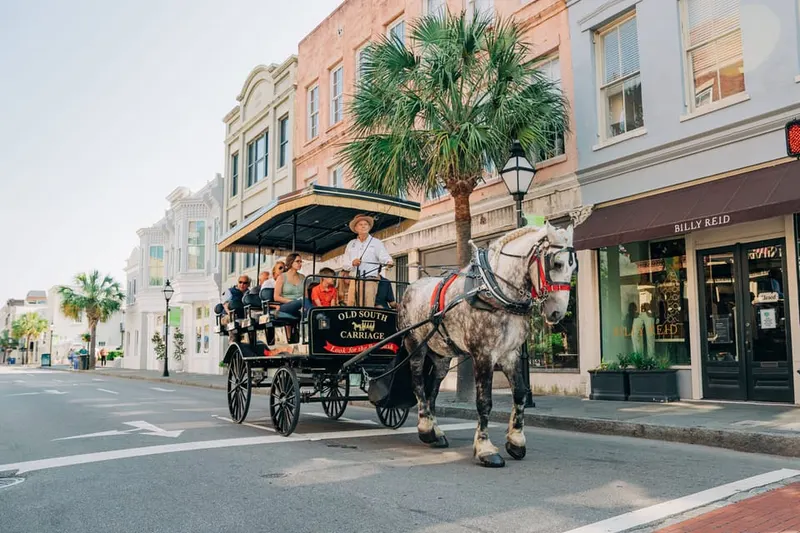
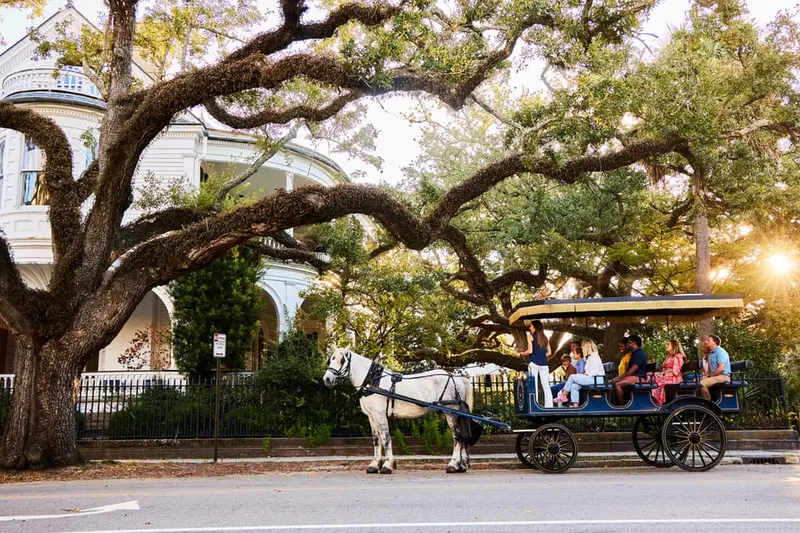


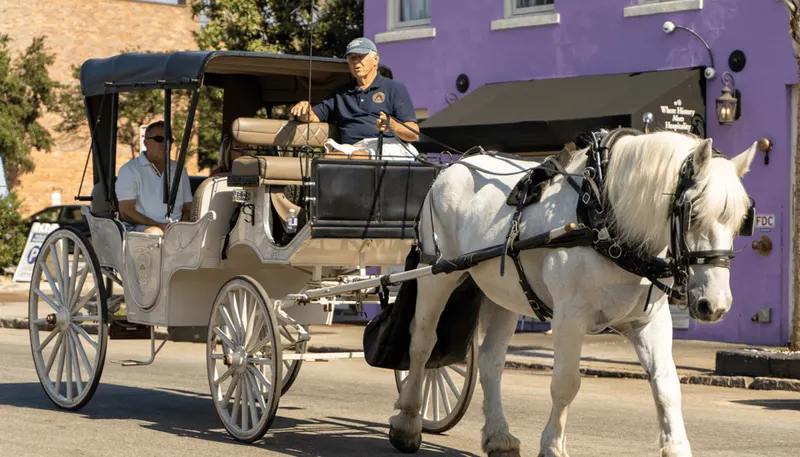

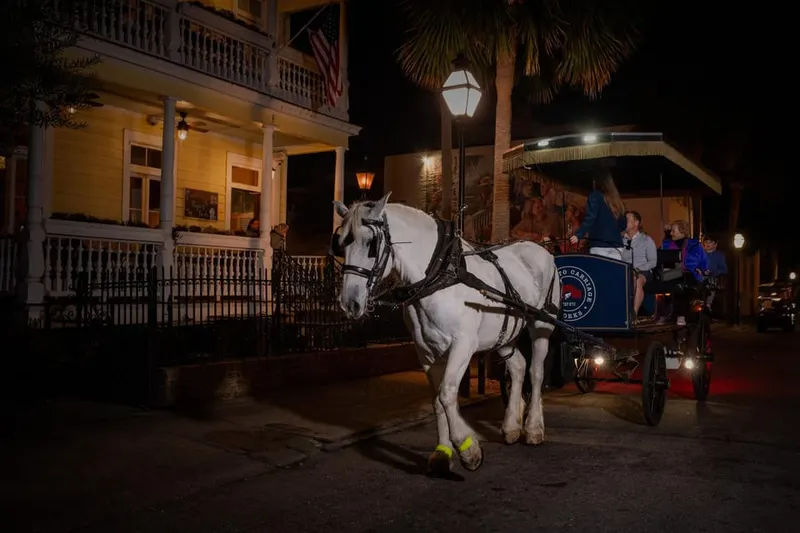

| Tour | Duration | Price | Rating | Best For | |
|---|---|---|---|---|---|
| Historical Downtown Tour by Horse-drawn Carriage
Top Pick
| 1 hour | $50 | ★ 4.8 (1249) | Daytime classic, most reviewed | Book Now |
| Historic Downtown Horse-Drawn Carriage Tour | 1 hour | $50 | ★ 4.9 (534) | Daytime classic, second opinion | Book Now |
| Haunted Carriage Evening Tour | 40 minutes | $45 | ★ 4.6 (481) | Most proven evening ride | Book Now |
| Evening Haunted Tour by Horse-Drawn Carriage | 45 minutes | $50 | ★ 4.5 (61) | Haunted ride, residential streets | Book Now |
| Charleston, SC: 1-Hour Private Daytime Horse & Carriage Tour | 1 hour | $250 / group | ★ 4.9 (28) | Private daytime, up to 4 | Book Now |
| Horse-Drawn Carriage Tour Past Historic Homes | 1 hour | $50 | ★ 5.0 (7) | Daytime history seat | Book Now |
| Evening Ghost Tour by Horse-Drawn Carriage | 45 minutes | $50 | ★ 4.9 (6) | Newer ghost option | Book Now |
| Historic Carriage Tour with Tailored Commentary | 1 hour | $325 / group | ★ 5.0 (1) | Private, with barn visit | Book Now |
How Charleston carriage tours actually work
Carriage tours are one of the most regulated things in Charleston. Every carriage has to check out a city medallion before it works, the animal-welfare rules come from ordinance rather than the companies, and, most surprising to visitors, the city assigns the routes. Shortly after your carriage loads, it stops at a small city gate near the City Market. Staff read the animal's microchip, count heads, note the carriage number, and a bingo-style lottery machine drops a ball whose color decides which of five zones your tour will cover.
Nobody, not the driver, not the company, not you, knows the route before that ball drops. If you booked a carriage ride specifically to roll past Rainbow Row or a particular mansion, understand the odds: with five zones, you have roughly a one-in-five chance of any specific sight. The system keeps carriages from clogging the same few blocks, and every zone runs through the historic district, so there is no bad draw. But if one landmark matters to you, walk there instead; the attractions guide covers the ones worth the detour.
The standard daytime history tour lasts about an hour and covers roughly 30 blocks. The big group carriages seat around 16 people on bench rows behind a licensed guide. Evening ghost carriages run shorter, 40 to 45 minutes, and the private carriages seat up to four, which is what you want for an anniversary or a proposal. The pace is a slow walk the whole way. It is the most relaxed way to cover the historic district, and the guide commentary is the actual product; the horse is just the drivetrain.
What the ride is actually like
You board at a barn, not a curb. The carriage companies keep their stables a few blocks east of the City Market, and the public carriages pull up to a raised platform inside the barn so the step across is almost level. That combination, no stairs and no walking, is why carriage rides are the default answer for anyone whose knees have opinions about cobblestones.
Wheelchairs do not fit on any carriage. If you use one, you have to transfer to a bench seat and leave the chair at the barn for the ride. Palmetto Carriage Works, at the Big Red Barn on 8 Guignard Street, is the one operator that publishes its setup: a ramp up to the boarding platform, a small gap to step across, two restrooms in the boarding area, and a spot to park a wheelchair, walker or scooter during the tour. Its smaller private carriages have a few steps, with a stool and staff help. Old South Carriage Company (14 Anson Street) and Charleston Carriage Works (20 Anson Street) publish nothing on access. The GetYourGuide listings in the table don't name their operator, except the private Historic Carriage Tour, which ends at the horse barn on 20 Anson Street. So after you book, call the operator named on your voucher and ask about the boarding step before you go (Palmetto's FAQ, palmettocarriage.com, checked October 30, 2026).
Once you are moving, the tour is a guide talking for 40 minutes to an hour while a horse or mule walks. Big public carriages seat up to 16 on bench rows, so it is not a private experience unless you pay for one. There is no getting off partway and no doubling back for a photo. Bring the camera and shoot from your seat.
Rain rarely cancels anything. The carriages have canopies but open sides, so a real downpour will find you; operators generally run unless the weather turns dangerous, and every tour in the table above has free cancellation if you would rather not ride wet. Ponchos travel better than umbrellas here, since umbrellas are not allowed on board. Heat is the thing that actually stops tours, and the rules for that are worth understanding before you book a July afternoon.
The rides, in order
Historical Downtown Tour by Horse-drawn Carriage has more reviews than every other carriage ride combined: 4.8 stars across 1,249, $50 per person, one hour. It is the standard daytime history tour on a big public carriage, and the default pick if you want one carriage ride and don't care about ghosts. Historic Downtown Horse-Drawn Carriage Tour is the same format with the second-largest review count, 4.9 stars across 534, at $50; it has its own breakdown page. Pick whichever has a departure that fits your afternoon.
Haunted Carriage Evening Tour is the proven evening ride: 4.6 stars across 481 reviews, $45 per person. It is a 40-minute twilight ride past haunted alleys, graveyards, and the old dungeon, with a licensed guide telling the stories. It has its own full breakdown page if you want the route details and booking advice before you commit.
Haunted Horse-Drawn Carriage Evening Tour is the next evening option, 4.5 stars across 61 reviews at $50. It runs 45 minutes through the residential blocks, where the guide works the histories of the old houses into the ghost material. Evening Ghost Carriage Tour is a newer listing at $50 for 45 minutes; its early average is 4.9 stars across 6 reviews, so treat the number as a small sample.
For daytime, Historic Residential Horse and Carriage Tour is a $50, one-hour history ride averaging 5.0 stars, though only across 7 reviews so far. The two private options are priced per carriage, and both labels in the table say so: the Private Daytime Ride is $250 for up to four people (4.9 stars, 28 reviews), and the Historic Carriage Tour is $325 for up to four, ending with a visit to the horse barn on Anson Street. Split among four, the private daytime ride works out to about $63 a head for a carriage to yourselves, which is why it shows up in our couples guide.
What about the walk-up barns?
Three big operators run high-volume tours from barns near the City Market: Palmetto Carriage Works (the red barn on Guignard Street, in business since 1972), Old South Carriage Company on Anson Street, and Charleston Carriage Works. They are the companies you see loading all day, and walking up to a barn works fine on a slow weekday. Their own tickets aren't among the ones we can link, so we won't quote prices or availability for them; check their sites for that. What we can say is that the route lottery applies to everyone equally, so a walk-up tour and a booked one see the same city.
The practical difference is the reservation. The tours in the table above hold your spot, take free cancellation up to a day ahead, and matter most in March, April, October, and December, when afternoon departures fill.
Is it humane? The honest answer
This is the most common objection to carriage tours, and it deserves a straight treatment. Charleston regulates the animals more tightly than most visitors expect. Since 2017, city ordinance halts all carriage tours after four consecutive readings, 15 minutes apart, of 95 degrees ambient temperature or a 110-degree heat index, down from the old 98/125 thresholds. The readings come from a rooftop station on Church Street near the carriage staging area, the city posts a live dashboard of carriage counts and temperatures, and a full-time equine manager is on staff. Horses get temperature checks around their tours, and an animal reading above about 103 degrees comes off the street to cool down. Loaded carriages are kept under three times the animal's body weight. The heat rule has teeth: the city halted tours 13 times over the summer of 2025 and 11 times in 2024.
Not everyone is satisfied. Charleston Animal Society has not called for a ban, but it argues the current system is not humane, points out that the official thermometers sit far above the asphalt the animals work on, and wants an independent study. Both positions are held by serious people. If you are uneasy, the evening tours run after the day's heat breaks, which is when city data shows a growing share of riders going anyway, or skip the carriage entirely. We break down that choice in carriage tour vs walking tour.
The ghost-carriage crossover
Half the bookable carriage rides in Charleston are ghost tours, and that is not an accident. The carriage schedule pushes into the evening to dodge the heat, evening is when ghost stories land, and the slow roll past dark alleys and graveyards suits the material. If the stories matter more to you than the horse, compare the walking options too; the ghost tour guide ranks all of them, and the walking tours get you inside places a carriage can only pass. In October, evening carriage and ghost slots both sell out days ahead, so book that trip early.
Christmas lights carriage rides in December
December is the peak month for Charleston carriage rides, and the reason is simple. The historic district decorates hard, with wreaths on every door and candles in the windows along the tour zones. The evening air is cool enough that the heat ordinance never comes into play, and a horse's walking pace is the right speed for looking at lights.
The evening rides in the table run all December and become de facto holiday-lights tours once the decorations go up. The walk-up barns add seasonal events too; Old South runs a short caroling Christmas ride with hot chocolate and Santa photos at its barn, a fixture for local families. Two cautions: December evening slots fill faster than any other month, so book ahead rather than counting on a walk-up, and the big drive-through light display at James Island County Park is a separate car-based event, the Holiday Festival of Lights, not a carriage ride. For the parades, markets and house tours that month, see Christmas in Charleston.
Which carriage tour should you book?
Historical Downtown Tour by Horse-drawn Carriage for a daytime history ride: 1,249 reviews at 4.8 stars, $50, one hour. Haunted Carriage Evening Tour if you want ghost stories and the evening slot that dodges the heat, at $45.
Private Daytime Ride if there are two to four of you and you want the carriage to yourselves; $250 covers the whole carriage, about $63 a head with four aboard.
Full breakdowns before you book
Full breakdown, pricing, and where to book each one:
Frequently Asked Questions
How much is a carriage ride in Charleston?
Shared carriage tours bookable online run $45 to $50 per person. Private carriages cost $250 to $325, but that covers the whole carriage for up to four people. The walk-up barns near the City Market sell their own tickets at the door; check their sites for current rates.
How long are Charleston carriage tours?
About an hour for the daytime history tours, which cover roughly 30 blocks of the historic district. The evening ghost carriage rides are shorter, 40 to 45 minutes. Private carriage tours typically run one hour.
Do carriage tours run in the heat?
Not past the cutoff. City ordinance halts all carriage tours after four consecutive readings, taken 15 minutes apart, of 95 degrees ambient or a 110-degree heat index, and they stay off the street until it cools. Summer afternoons get suspended regularly; mornings and evenings usually run.
Can you choose your carriage route?
No. The city assigns each departing carriage one of five zones by random lottery, a bingo-style draw at a gate near the City Market. No company can promise a specific street or landmark, so figure roughly a one-in-five chance of passing any particular sight. Every zone is in the historic district.
Are Charleston carriage tours humane?
The city sets heat cutoffs, employs a full-time equine manager, and requires horse temperature checks; loaded carriages stay under three times the animal’s body weight. Charleston Animal Society has not called for a ban but argues the current system is not humane and wants an independent study.
Can you ride a Charleston carriage tour in a wheelchair?
Not in the chair. Wheelchairs don't fit on the carriages, so you transfer to a bench seat and the chair waits at the barn. Palmetto Carriage Works on Guignard Street has a ramp to its boarding platform, a small gap to step across, and storage for wheelchairs and scooters; its private carriages have a few steps, with a stool. Old South and Charleston Carriage Works publish no access details, so call the operator on your voucher before you go (checked October 30, 2026).
Are there Christmas lights carriage rides in Charleston?
Yes. Evening rides through the decorated historic district are a December tradition, and some barns add caroling rides with costumed drivers and Santa photos. December is the busiest month of the year for carriage rides, so book evening slots several days ahead or line up early at the barns.
Rather see Charleston another way?
The full guides cover walking tours, harbor cruises, and everything else worth your time downtown.
Disclosure: booking links on this page go to GetYourGuide, Expedia or Vrbo. If you book through one, this site earns a commission at no extra cost to you. It never changes which tours we recommend — see how we pick.