The best indoor things to do in Charleston
Charleston has more indoor depth than its garden-and-waterfront reputation suggests, and almost all of it sits within a mile of the City Market. Here is the list in the order most visitors should work through it.
South Carolina Aquarium, 100 Aquarium Wharf. The best indoor hours in the city with children under ten. The Great Ocean Tank holds 385,000 gallons, drops 42 feet, and is the deepest aquarium tank in North America. Downstairs is a working sea turtle hospital, included with every ticket. Open daily 9 a.m. to 5 p.m., last entry 3:30, about two hours for a visit. Dynamic pricing, recently $29 to $38 for adults and $23 to $30 for children 3 to 12. The Sea Turtle Cafe serves lunch from 11 to 3, so a storm can pass without you leaving the building. More on our South Carolina Aquarium page.
Patriots Point, 40 Patriots Point Road, Mount Pleasant. The answer when you have half a day to kill. The USS Yorktown is an 872-foot aircraft carrier you tour on your own, and the hangar bay and everything below it stay dry in a downpour; the Vietnam Experience, on land, does not. Budget three to four hours. Open daily 10 a.m. to 5 p.m., ticket window closing at 4, $28 adults and $23 for children 6 to 12 (2026 advance online), parking separate at $5.50 an hour up to $25. The catch is the stairs: warship ladders are steep, narrow, and everywhere. Read our Patriots Point guide before committing anyone with bad knees.
The Charleston Museum, 360 Meeting Street. Founded on January 12, 1773, open Monday to Saturday 9 a.m. to 5 p.m. and Sunday noon to 5. Adult admission is $15 for the main building; combination tickets add two historic houses the museum owns, the 1772 Heyward-Washington House on Church Street and the 1803 Joseph Manigault House up the block, at $22 for two sites or $30 for all three. On a wet day that combination is a trap, because the Heyward-Washington House is a mile's walk south. Buy the single site, give it 90 minutes to two hours, and note tickets stay valid a year. There is a coat check for wet umbrellas. More on our Charleston Museum page.
Gibbes Museum of Art, 135 Meeting Street. A 1905 Beaux Arts building holding more than 10,000 works of American art tied to Charleston and the South. It is known nationally for its 600-plus portrait miniatures, watercolor on disks of ivory small enough to sit in your palm; the other room worth your time covers the Charleston Renaissance of 1915 to 1945. Adults pay $20, ages 8 to 17 pay $12, and the entire first floor is free to anyone who walks in. Most people see it in an hour. Two scheduling notes for bad weather: it closes Tuesdays, and Wednesday is the one late night, open until 8 p.m. See our Gibbes Museum guide.
The Old Slave Mart Museum, 6 Chalmers Street. The most important indoor hour in Charleston, and the one most visitors skip. The building is Ryan's Mart, built in 1859 after an 1856 ordinance pushed slave auctions off the street into private salesrooms, and it is the only building known to survive in South Carolina that was used as a slave auction site. Sales ended in November 1863; the city bought it in 1988 and opened it as a museum in 2007. It is a reading museum of panels, documents, and bills of sale. Open Monday to Saturday 9 a.m. to 5 p.m., closed Sunday, $8 as of 2026. Give it an hour; a poor fit for young children. Chalmers Street is uneven ballast cobblestone that defeats strollers, so approach from the Church Street end.
The Old Exchange and Provost Dungeon, 122 East Bay Street at Broad. Weather is irrelevant here, because the part you came for is underground: a 1771 customs house above, and beneath it the brick-vaulted cellar the British Army ran as a military prison during the 1780 to 1782 occupation. One $16 adult ticket covers both, children 7 to 12 pay $12, and the guided dungeon tour runs 25 minutes, departing every half hour from 10 a.m. Open Monday to Saturday 9 to 5 and Sunday 11 to 5, and an elevator reaches all three floors. A discounted combination ticket with the Old Slave Mart, five minutes away, is sold at both sites. Details on our Provost Dungeon page.
The City Market, 188 Meeting Street. Partial credit only, and the distinction matters before you walk over. The market is four sheds running about 1,240 feet from Meeting Street to East Bay, and just one of them, the Great Hall behind Market Hall, is fully enclosed and air-conditioned. The rest are covered but open-sided: a roof keeps vertical rain off you and does nothing about wind-driven rain. Free, open daily 9:30 a.m. to 5:30 p.m., good for waiting out a twenty-minute shower and a poor plan for a wet afternoon. The City Market guide covers the sweetgrass basket weavers, who are the actual reason to go.
One more worth checking: the International African American Museum on Gadsden's Wharf, opened in 2023 where an estimated 100,000 enslaved Africans were landed. Confirm its hours before you plan around it, after the 2026 staff furloughs. The rest is in our Charleston attractions index.
Why a food tour is the best rainy-day booking
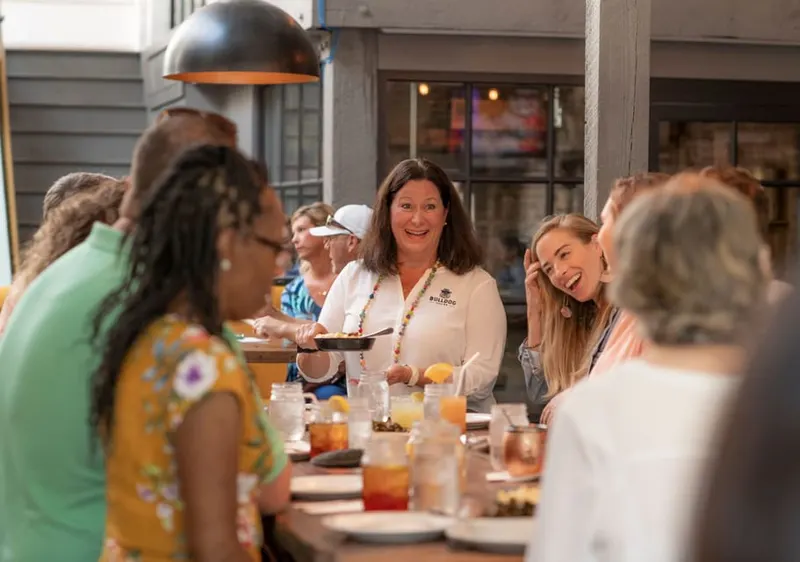
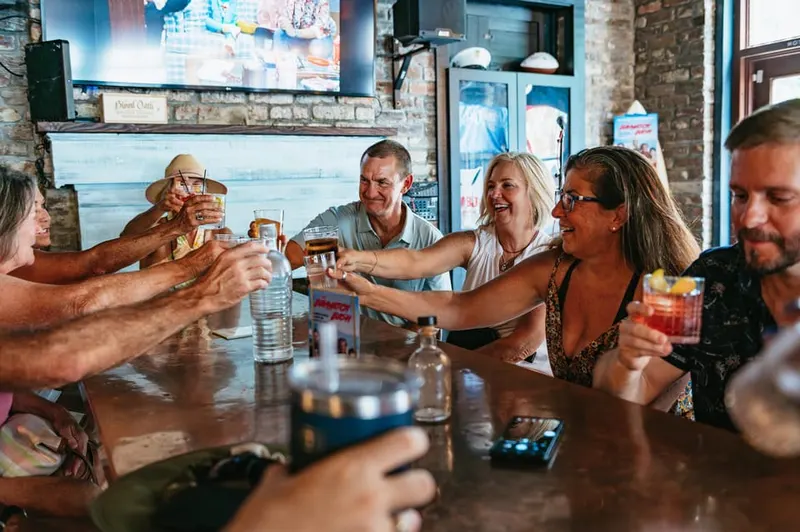
Every other tour in Charleston is worse in the rain. A food tour is the exception, and the reason is structural: you are sitting inside a restaurant for most of the two to three hours, and the walking is a few blocks between covered doors. Five to seven stops, tables booked ahead, and nothing on the itinerary that depends on the sky.
Operators run rain or shine and reschedule for severe weather. Book early rather than on the morning, because a bad forecast pushes every other visitor toward the same handful of indoor options and the good food tours go first. Our Charleston food tours guide compares the operators, and what you actually eat on a food tour sets expectations.
What still runs in the rain
Walking and ghost tours. Most continue in light rain. Guides carry on with umbrellas, and a wet night suits a ghost tour better than a clear one. Heavy downpours and thunderstorms trigger a reschedule or refund, so check the operator's weather policy when you book.
Carriage tours. The carriages have canopies but open sides, so a real downpour will find you. Operators generally run unless conditions turn dangerous, and umbrellas are not allowed on board, so pack a poncho. Most bookings carry free cancellation if you would rather not ride wet. Our carriage tours guide explains the zone lottery that sets your route.
Harbor cruises. These usually sail in light rain. What stops them is lightning, sustained wind above roughly 20 knots, or rough water; the captain calls it, operators contact you before departure, and most reschedule without penalty. The caveat is that a harbor cruise under low gray cloud is a poor version of what you paid for even when it sails. Move it to a clearer day.
What to skip when it rains
The plantations. Magnolia, Middleton Place, Boone Hall, Drayton Hall, and McLeod all sell you grounds. Middleton's gardens are effectively the entire product, house tours often queue outdoors, and the walking between buildings is the visit. Add half an hour of driving each way and it is the worst value in the Lowcountry.
The beaches. Obvious, with one detail people forget: Folly Beach, Isle of Palms, and Sullivan's Island all charge for parking, so a wet beach run costs money before it disappoints you.
Angel Oak. A tree in a field on Johns Island, about 12 miles out, free to visit because there is nothing there but the tree. The drive is the cost, and rain removes the reason to make it.
The flooding problem nobody warns you about
Heavy rain in Charleston behaves differently than elsewhere, and it catches visitors out every year. The peninsula is low and flat, and its storm drains empty into a harbor that is sometimes higher than the streets. When a downpour lands on top of a high tide, the water has nowhere to go and comes back up through the drains.
The scale is easy to underestimate. Minor flood stage at the Charleston Harbor gauge is 7 feet, and the gauge topped that mark on more than 50 days in each of 2024 and 2025, close to one a week. Most involved no rain at all; that is tide alone putting water in the street. Add a downpour on the same afternoon and low intersections go under.
As a visitor it looks like standing water at the low corners, most often around the Market, on lower King Street, and along the Battery, which goes first and worst. It drains within an hour or two once the tide turns. Cars stall in it, and people who live here do not drive into water they cannot see the bottom of.
The fix is one minute of planning. Check the day's high tide against the forecast; NOAA publishes free tide predictions for Charleston Harbor. If the high is near or above 7 feet and rain is due in the same window, be inside for those two hours rather than walking between museums, and do not park on a low street. Our Charleston in September guide goes deeper on the tide-gauge numbers, because September brings the year's highest tides.
How to build the day
A workable wet day downtown: start at the Charleston Museum when it opens at 9, walk 15 minutes down Meeting Street to the Gibbes for an hour, eat lunch on King Street, then take the Old Exchange and the Old Slave Mart on the combination ticket. That is a full day, indoors, inside a mile. With children, swap it for the Aquarium in the morning and Patriots Point after. If you would rather book one thing and stop thinking, book the food tour.